Reseller Inventory Management Software for Pallet Sellers
By Editorial Team ·
On this page
- Why Pallet Resellers Outgrow Spreadsheets and Sticky Notes
- What Reseller Inventory Management Software Needs to Do
- Tracking Incomplete Product Sets
- Multi-Marketplace Listing Control
- Choosing Between Free and Paid Inventory Tools
- Setting Up Your Physical Storage and Item Records
- Building a Reseller Inventory Tracking Spreadsheet That Actually Works
- Columns That Carry Their Weight
- Formulas Worth Setting Up
- Validation That Prevents Drift
- Reconciling the Sheet Against the Bins
- When to Graduate to Software
- Preparing Your Records for an In-Person Set Exchange
- Start Matching Your Partial Sets Before Your Next Pallet Arrives
- Frequently Asked Questions
Last Updated: October 30, 2026
Quick Summary
Reseller inventory management is the practice of tracking what you own, where it sits, and what it cost you, which matters most for pallet sellers handling partial sets. Good software treats each partial set as its own record, notes which components are present and missing, and records cost against the whole set. A spreadsheet can also work if it uses one row per set and fixed status values.
- Treat each partial set as a first-class record with components present and missing.
- Record purchase cost against the set, not each loose item, to keep margins honest.
- Test any free tier with one real pallet before paying for a plan.
- Export your records to a spreadsheet to confirm you can leave the tool without losing data.
- Reconcile physical bins against your records by counting one shelf or zone each week.
Why Pallet Resellers Outgrow Spreadsheets and Sticky Notes
Most pallet buyers start with a notebook, a phone photo roll, and a shared spreadsheet. That works when you buy one pallet a month.
The real cost is not the spreadsheet itself. It is the lost sale.
Find The Other Box is built for this exact problem: individual resellers holding one half of a set and looking for the person with the other half. Before you choose any software, it helps to know what it has to do.
What Reseller Inventory Management Software Needs to Do
Good reseller inventory management software does three jobs well. It tells you what you own, where it sits, and what it cost you. Everything else is secondary.
For pallet sellers, the bar is higher than for a shop that buys finished goods. Your inventory arrives partial, mixed, and unlabeled. The software has to handle that messiness without forcing you into a rigid catalog structure.
Tracking Incomplete Product Sets
A partial set is the core unit of pallet resale, so your software should treat it as a first-class record. If you need help locating the specific missing box or component for a partial set, see How to Find Missing Product Components for Your Pallet Sets.
Record the purchase cost against the set, not against each loose item. That keeps your margin calculation honest when you sell a set in parts or match it with another reseller.
Multi-Marketplace Listing Control
Many pallet sellers list the same item on more than one marketplace. Without control, the same unit can sell twice. Look for a system that holds one master quantity and reduces it when any channel sells, or at least makes the conflict visible before you ship.
Even if you sell locally rather than online, keep a single source of truth. A physical handoff to another reseller still needs to be recorded once, in one place.
Choosing Between Free and Paid Inventory Tools
Free inventory tools are a reasonable starting point for an individual pallet buyer. Most offer a basic item list, photo attachments, and simple status tags.
Paid tools add features such as automated listing updates, deeper sales reports, multi-user access, and version history.
Rather than comparing brand names, evaluate any tool against the workflow you actually run. A practical checklist for a pallet reseller:
- Partial-set records. Can you store one record per set with fields for components present and components missing, or does the tool force one record per SKU? If it forces SKUs, you will end up rebuilding entries every time a set changes shape.
- Photo capacity. How many photos per record, and are they stored at full resolution? You need clear shots of labels, model numbers, and condition to confirm a match before an in-person meetup.
- Status values. Can you define fixed statuses such as Holding, Seeking match, Matched, and Sold, or are you stuck with free-text notes that drift in spelling?
- Cost fields. Can you record purchase cost against the set rather than each loose item, so margin stays honest when a set sells in parts?
- Export and portability. Can you export your full item list, costs, and notes to a spreadsheet? If you outgrow the tool or it changes its plan limits, you need your data out without retyping.
- Change history. Does the tool log edits? After a handoff, a timestamped note of what changed and when is your best evidence if a condition dispute comes up.
- Offline access. Can you view your records on a phone without a signal? Storage units and parking-lot meetups are not always connected.
A common pattern among individual pallet buyers is to start free, hit the item cap within a few pallets, and then pay for the next tier.
Pricing and plan limits change often, and they differ by provider. Check each vendor's current pricing page before you commit, and treat any free tier as a trial you are actively testing.
The article's checklist gives a practical starting point for comparing any tool against a pallet reseller's workflow.
| Checklist item | What to check | Why it matters |
|---|---|---|
| Partial-set records | One record per set with present and missing components | Avoids rebuilding entries when a set changes |
| Photo capacity | Enough photos at full resolution | Confirms matches before an in-person meetup |
| Status values | Fixed statuses such as Holding and Matched | Prevents spelling drift that breaks filters |
| Cost fields | Cost recorded against the set | Keeps margin honest when a set sells in parts |
| Export and portability | Full export to a spreadsheet | Lets you leave the tool without retyping data |
| Change history | Timestamped edit log | Gives evidence after a condition dispute |
| Offline access | Records viewable without signal | Works at storage units and parking-lot meetups |
Setting Up Your Physical Storage and Item Records
Your physical setup should mirror your digital record. Assign each shelf, bin, or floor zone a short code, and write that code on the bin and in your inventory entry.
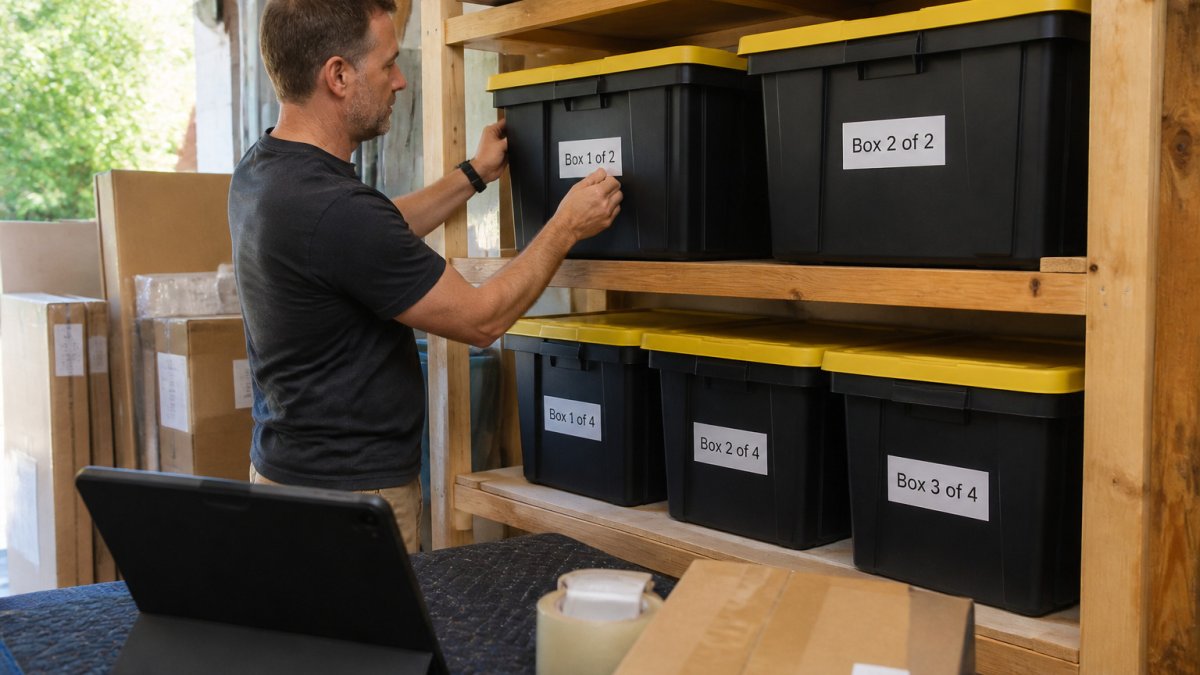
Keep partial sets in their own bins, separate from complete items. Label each bin with the set name and the number of components it holds.
Take one clear photo per bin when you store it.
Building a Reseller Inventory Tracking Spreadsheet That Actually Works
If you are not ready for software, a spreadsheet can work well with the right structure. The structure matters more than the tool. Use one row per partial set, not one row per pallet, and build in validation so the sheet stays trustworthy as it grows.
Columns That Carry Their Weight
Start with these fields: set name, storage location code, components present, components missing, purchase cost, date acquired, status, and sale or match notes. Add a photo link column pointing to a shared folder, and a last-updated column so you can see which records have gone stale.
Two columns do most of the work. The components present and components missing fields should be short, consistent text, not paragraphs. A pattern like "Box 1 of 2, cord, manual" is searchable; a paragraph is not.
Formulas Worth Setting Up
- Total cost per set. If you split a pallet cost across sets, keep a helper column for the allocated share and sum it. A simple
=SUM()across the cost columns keeps margin honest when a set sells in parts. - Days held.
=TODAY()-E2where E2 is the date acquired. This flags aging stock before it becomes dead stock. - Match flag. A formula that returns "Seeking" when components missing is non-empty and status is Holding, so you can filter to the sets that actually need a counterpart.
- Duplicate check. A count-if formula on set name plus location code surfaces accidental double entries, which are the most common cause of a phantom sale.
Validation That Prevents Drift
Use a data validation dropdown for status with fixed values: Holding, Seeking match, Matched, Sold, Returned. Fixed values prevent the spelling drift that makes filtering unreliable. Apply the same discipline to location codes: a short list of approved codes, enforced by validation, stops "Garage shelf 2" and "garage shelf two" from becoming two different places.
Reconciling the Sheet Against the Bins
A spreadsheet is only as good as its last reconciliation. Once a month, walk your storage with the sheet open and count what is in each bin. Compare the count to the row, and fix any gap immediately. Small errors compound quickly across hundreds of partial sets, and an unreconciled sheet is worse than no sheet because it creates false confidence.
A practical cycle-count routine for an individual pallet buyer:
- Pick a rotation, not the whole room. Count one shelf or zone per week so the job stays small.
- For each bin, confirm the set name, the components present, and the status match the row.
- Flag any row where the physical bin and the record disagree, and resolve it the same day.
- Note the count date in a header cell so you know when the sheet was last verified.
When to Graduate to Software
The spreadsheet starts to fail when you need change history, multi-device access, or photo storage beyond a shared folder. Those are the signals to move to a dedicated tool, and the export you built here becomes your import file. Keep the column names clean and consistent so the migration is a mapping exercise, not a rebuild.
Preparing Your Records for an In-Person Set Exchange
Most partial-set matches between individual resellers end in a local, in-person handoff. Before you meet, confirm the exact components on both sides: model, box number, and visible condition.
Record the agreed exchange in your inventory the same day. Note the other reseller's handle or first name, the date, the location type, and what changed hands.
Decide in advance which items you will split or bundle. A partial set that is worth more as one unit should not be broken down at the meeting.
Start Matching Your Partial Sets Before Your Next Pallet Arrives
The fastest way to recover value from stranded stock is to start matching now, not after the next pallet fills your storage space.
Find The Other Box is designed for this step. You can list the partial sets you hold and find other resellers who have the components you need. Start matching for free, then build your tracking system around the sets that actually move.
Frequently Asked Questions
What software do resellers use to manage inventory?
Resellers use a range of options, from general spreadsheets to dedicated inventory apps and marketplace-linked tools. Dedicated software usually adds item records, stock location fields, listing sync and sales tracking. Which one fits depends on how many items you handle, how many marketplaces you sell on and whether you need a free plan. Compare feature limits on each provider's website before committing, since pricing and plan details change and are not listed here. Find The Other Box can also help you match partial sets with other resellers when you have items you cannot sell alone.
Can inventory software track products listed on multiple marketplaces?
Many reseller inventory tools can record one item and show where it is listed, which helps prevent duplicate sales. Look for listing sync or manual status updates so that a sale on one platform marks the item as sold everywhere. Check whether the tool supports the specific marketplaces you use, since integration coverage varies by provider. Even with software, do a periodic physical count to confirm that your records match what is on your shelves.
How can resellers organize partial or incomplete product sets?
Give each partial set its own item record and note which pieces are present and which are missing, such as Box 1 of 2 or Box 2 of 3. Store the matching pieces together in one labeled bin so you can see at a glance what you have. When you meet another reseller to exchange pieces, your record shows exactly what you need and what you can offer. Keep the set's purchase cost on the same record so you know your investment before you trade.
How do small resellers keep track of inventory?
Small resellers usually start with a spreadsheet and move to an inventory app once the item count grows. Record each item's purchase date, cost, storage location and status from the moment it arrives. Update the status when you list it, when you sell it and when you trade it. A weekly count of a few bins at a time is easier to keep up with than a full audit once a year.